Precedent lives in inboxes
Notices, drafts, opinions, and negotiated clauses sit inside personal folders that leave with the person who wrote them.
Advocate-reviewed assistant, not a lawyer replacement
The Precedent Hub gives firms and legal teams a private institutional knowledge layer for documents, citations, drafting support, and usage proof.

Memory layer
Search private work product, inspect citations, draft with support, and keep the professional reviewer in control.
Where firm knowledge leaks
Case-law databases hold what the country decided. Firms are built on what they have written, argued, negotiated, and advised. That knowledge usually lives outside any single system.
Notices, drafts, opinions, and negotiated clauses sit inside personal folders that leave with the person who wrote them.
Every partner or associate keeps their own version. Standard positions become inconsistent, and review time grows quietly.
Reported judgments matter, but they do not capture how the firm has argued, negotiated, or advised in the past.
When a matter moves between people, the reasoning behind past choices is often the first thing that disappears.
Use-case switcher
Different teams bring different files, but the operating need is the same: reuse knowledge without losing source discipline.
Reusable pleadings, research notes, templates, and matter memory for litigation and advisory teams.
Internal opinions, contract positions, approval patterns, and policy answers with support.
Compliance notes, filings, board materials, and recurring advisory work organized for reuse.
Regulatory memos, audit responses, obligation notes, and evidence trails for repeat questions.
Clause banks, deviations, bid positions, and negotiated language with provenance.
Workflow
The workflow is deliberately conservative: source-first retrieval before generation, and human review before any legal work leaves the team.
01
Upload firm work product, templates, research notes, policies, and selected public-law support.
02
Search returns passages and sources, so the user can inspect why an answer was suggested.
03
Notices, responses, clauses, and memos start from retrieved material rather than memory alone.
04
Teams can see which collections, matters, and source-backed drafts are being used.
Sample citation output
A drafted answer without traceable support does not leave the workbench. The example below shows the operating shape of a firm question, its answer, and the sources the answer is grounded in.
Question
What has the firm previously argued on limitation for a delayed statutory notice?
Grounded answer
A retrieved answer would summarize the firm’s past position, cite the specific memo or pleading, and expose the passages the answer relied on. The user can open each source before deciding whether to reuse the reasoning.
Support cited
Memo — 2024-06-12
Litigation team internal opinion on notice delay and condonation.
Pleading draft — 2023-11
Reply to reference in a comparable matter, marked as reusable.
Client advisory — 2024-02
Position sent to client with caveats about jurisdictional variance.
Each source is a firm document, opened in one click before reuse.
Product surfaces
Search, drafting, and usage proof are the core public proof points. Each surface reinforces private-memory behavior.
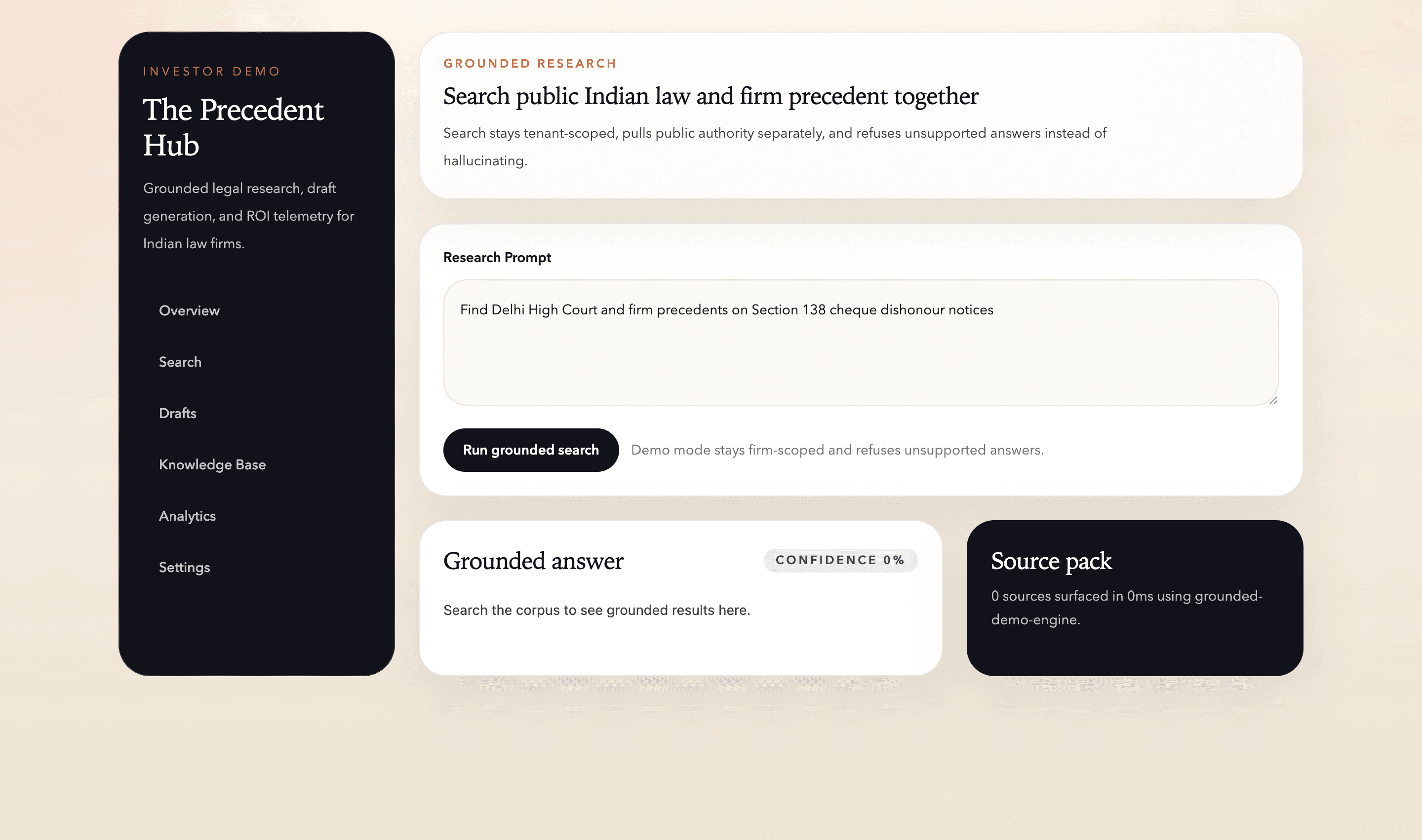
Private research search with citations and matter context.
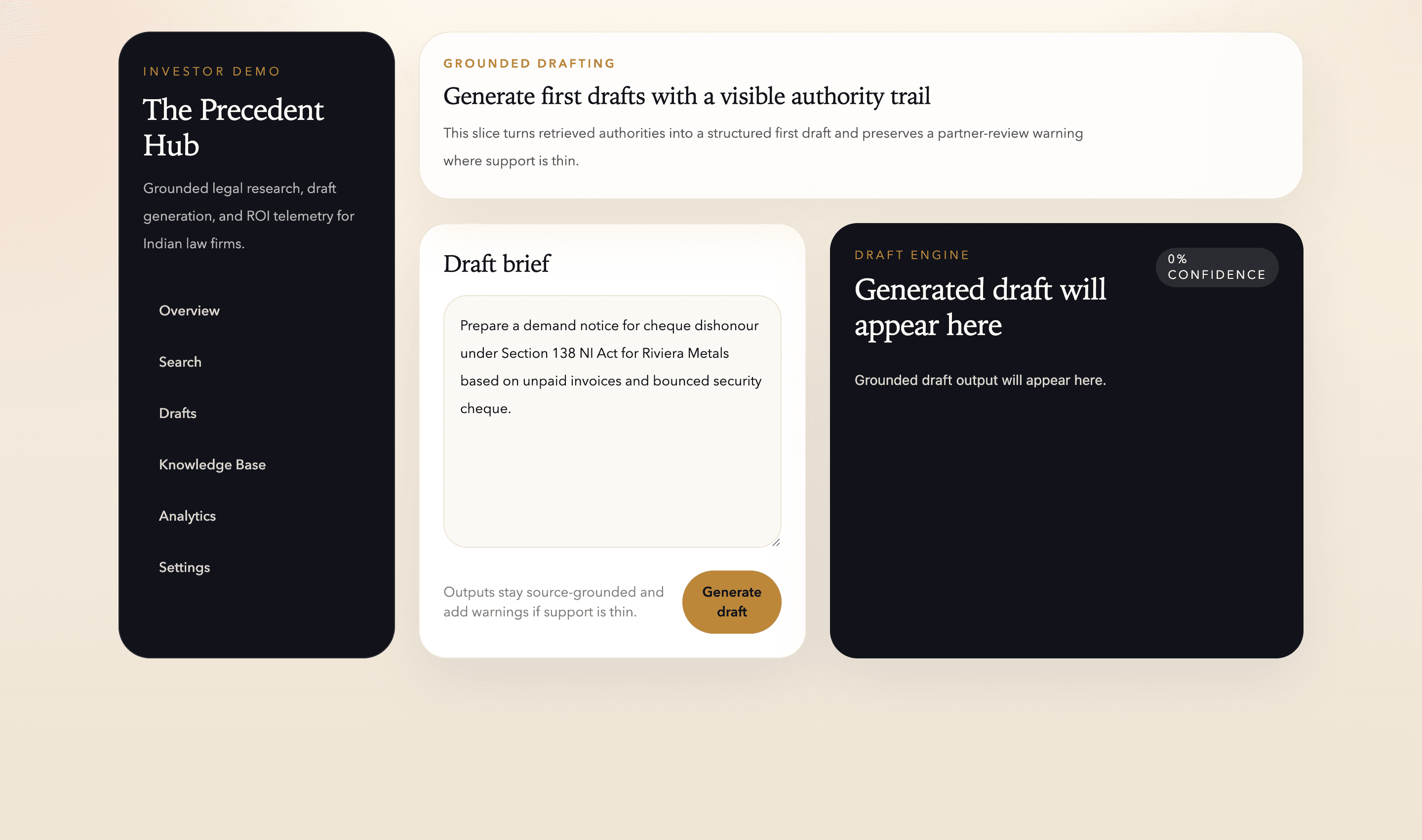
Draft generation grounded in selected support and reusable templates.
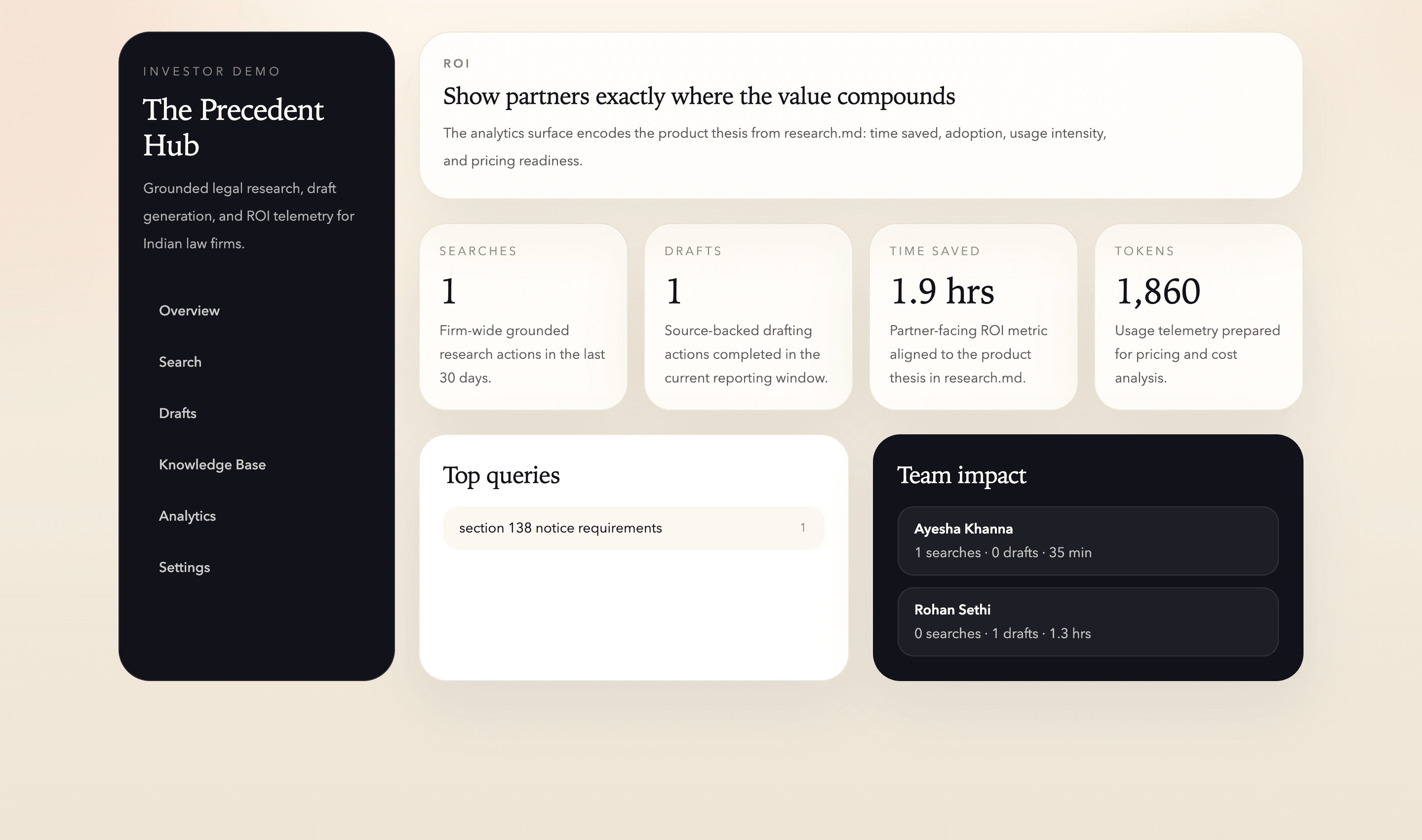
Operational visibility into searches, drafts, collections, and adoption.
Residency and posture
Data residency, tenant scoping, and DPDPA-aware handling are decisions that belong in the operating design, not in a vendor footnote.
Firm documents and derived indexes are handled inside Indian data-region infrastructure as the default posture.
Every retrieval and draft query is scoped to the firm, not enforced only by row-level policies as a fallback.
The rollout defines lawful basis, retention, and access rules per firm rather than a single vendor default.
Search, retrieval, and drafting activity can be reviewed by an admin without exposing document content out of tenant.
Trust boundaries
A legal AI product cannot hide its operating posture. Tenant boundaries, citations, refusal behavior, and professional accountability are part of the product story.
Firm material should stay scoped to the firm or organization that supplied it.
Answers should expose supporting passages and refuse when support is weak.
The assistant supports review. It does not replace professional legal judgment.
Usage and collection health belong in the product, not in a hidden vendor report.
Pilot shape
A pilot is small enough to run in weeks and specific enough to prove or disprove the reuse loop before wider rollout.
01
A single team or practice area – litigation, contracts, compliance – rather than the whole firm at once.
02
Templates, standard positions, memos, and matter files that this team already treats as reusable.
03
What can be surfaced, what must remain restricted, and how support must be shown before a draft.
04
Named lawyers who review outputs, flag hallucinations, and shape the operating discipline.
05
Searches, opened citations, accepted drafts. Not vanity numbers.
Where it fits
The Precedent Hub sits alongside case-law research, generic AI assistants, and shared drives. Each of them keeps doing what they are good at. The private memory layer is the missing one.
Necessary for reported judgments and statute research. Not designed to hold private precedent, past positions, or negotiated language.
General LLMs answer without knowing the firm. They cannot cite firm memos, and their answers cannot be audited against firm work.
Store files, but retrieval is by filename and folder, not by the actual legal question a lawyer is trying to answer.
Focuses on private precedent with citation discipline, tenant isolation, and drafting grounded in retrieved firm material.
FAQ
These answers keep the public page accurate while leaving deployment details to the implementation discussion.
No. The Precedent Hub is positioned as an advocate-reviewed research and drafting assistant. Lawyers and responsible professionals remain accountable for final work.
Public-law databases are useful, but they do not become a private memory layer for a firm or company. This product focuses on private precedent plus citation-aware retrieval.
Yes. The same pattern works for private policy answers, regulatory notes, recurring filings, board material, and audit response history.
No such claim is made. The correct deployment posture is tenant-scoped document handling and retrieval, with boundaries agreed before rollout.
The primary operating language today is English, with support for Hindi-English content in supplied firm material. Multilingual retrieval quality should be validated in the pilot for each firm.
Talk to Top Notchh about a PrecedentHub pilot for a firm, legal department, compliance team, or managed white-label offering.